If you’ve written content for your website, you’ve probably asked yourself:
“Why is my competitor ranking above me in Google even though my content is better?”
The truth is that Google no longer ranks content based only on keywords. Today, it evaluates something much deeper – whether it can trust you.
In 2026, there is one major problem – the internet is flooded with perfectly written AI-generated content.
Anyone can generate content in seconds. Everything sounds good, is well-structured, optimized… but there is one issue:
AI has no real experience. It has never been on-site. It has never worked with a client. It has never solved a real problem.
And this is exactly where E-E-A-T in SEO comes in – the concept that determines whether your content appears on the first page or stays invisible.
Google uses this framework to distinguish:
- content created by a real expert
- from mass AI-generated content
This “human footprint” is what pushes you above the competition.
If you want to understand how to build trust in Google’s eyes and start ranking higher, this GrowEasy article will give you a clear picture.
What Is E-E-A-T in SEO?
E-E-A-T stands for four key elements that Google uses to evaluate the quality of your content: Experience, Expertise, Authoritativeness, and Trustworthiness.
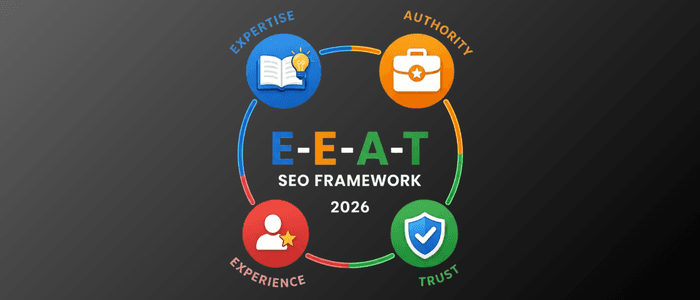
But the most important thing is not just understanding the words, but what Google actually wants to see.
The search engine no longer asks: “How well is the text written?”
Instead, it asks:
“Can I trust the person or brand behind this content?”
And if the answer is “no,” your chances of high rankings drop, no matter how well you optimize your website or keywords.
Why E-E-A-T Is So Important for SEO Rankings
You can have perfectly written content, but if Google doesn’t recognize trust in it, it won’t reach users.
The reason is simple – Google wants to show results that are safe, accurate, and useful. Especially in topics like health, finance, services, and business decisions.
Here, E-E-A-T acts as a filter. It helps Google decide:
Who deserves to be on the first page and who does not?
Ask yourself honestly:
If Google had to choose between your site and a competitor’s, why should it choose you?
The Four Elements of E-E-A-T (and What They Really Mean for You)
The first part – Experience – means whether you are speaking from real experience. Google now values content that shows you have actually “done it in practice,” not just described it. Experience is exactly what AI cannot fully imitate.
In the past, “experience” simply meant knowing the topic. In 2026, that is no longer enough. Google looks for proof of real lived experience.
This includes:
- original photos from the process
- video demonstrations
- real case studies
- specific details only a practitioner would know

For example:
Saying “Google Ads works well” is not experience. But saying “in a campaign with Broad Match + Smart Bidding we saw a 27% drop in CPA after 3 weeks” – that is.
If your content has no original proof or personal insights, Google assumes you have no Experience. Expertise is related to your knowledge. It is not enough to know the basics – you must show deep understanding of the topic.
Authoritativeness comes from whether other people and websites recognize you. This includes backlinks, mentions, and reputation in your niche.
Trustworthiness is the foundation. If your site does not look reliable – with clear information, contacts, a real brand, and transparency – the other factors lose power. Google officially places Trust at the center of E-E-A-T.
You may have:
- experience
- expertise
- authority
But if your website doesn’t look trustworthy… none of it matters.
And here is the key takeaway: E-E-A-T is not a technical trick, but a trust-building strategy.
What Does Trust Mean in 2026?
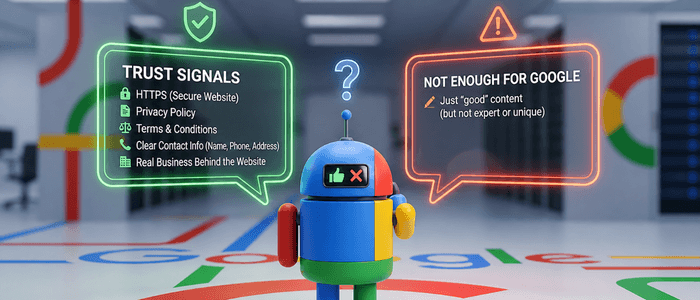
Google and its AI systems (including “Jarvis”) look for clear signals:
- HTTPS (secure website)
- privacy policy
- terms and conditions
- clear contacts (email, phone, address)
- a real brand behind the website
Ask yourself:
If you landed on your website for the first time – would you trust it?
What Happens If Trust Is Missing?
Google simply won’t recommend you. Even if you have good content. Even if you are an expert. Without trust → no rankings.
How to Improve E-E-A-T in SEO in Practice
If you’re wondering how to move your website up in Google, the first step is to look at your content honestly.
Does it show real experience? Or does it sound like rewritten internet information?
Then think about authorship. Is it clear who is behind your content? Or does your site look anonymous? Google wants to know there is a real expert or brand behind the words.
Another key element is evidence – case studies, results, examples, even client testimonials. These build trust much more strongly than any keyword.
And there is an interesting connection – even tools like Google My Business matter. Why? Because reviews, local presence, and activity there are also trust signals for your brand in Google’s eyes.
Example
To make it clearer how E-E-A-T works in real life, let’s look at a simple example.
Imagine two websites offering the same service – for example Google Ads for businesses.
The first website has well-written text full of keywords, but no information about who is behind it. No author, no expert identity, no real results or client stories.
The second website also has content, but adds something different – a clearly presented team, real case studies (e.g. “we increased leads for a client by 63% using Google Ads”), work photos, reviews, and an active Google My Business profile with real feedback.
Which one do you think Google will rank higher?
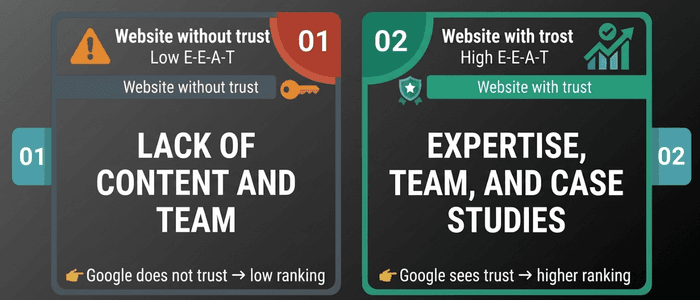
The answer is almost always the second website, because it shows E-E-A-T signals – experience, expertise, authority, and most importantly trust.
This is the key point many businesses miss:
It is not enough to say you are good – you have to show it.
The Most Common Mistakes That Destroy E-E-A-T
Many websites fail not because they lack content, but because they lack trust.
One of the most common mistakes is anonymous writing – no author, no expertise, no face behind the brand.
Another is “empty content” – texts that sound good but say nothing specific.
And last but not least – lack of real proof. Google no longer believes promises, only signals.
Take a look at the difference between cheap SEO optimization or high-quality SEO.
How Google Recognizes E-E-A-T in the Real World
Google does not “see” E-E-A-T directly, but it understands it through signals.
This includes how users interact with your site, how long they stay, whether they return, and whether they search for you by name.
It also looks at external signals – links from other websites, mentions, reviews, and your overall online presence.
This means something important: SEO is no longer just about a website – it is about a brand.
How Long Does It Take to Build Strong E-E-A-T?
High-quality SEO optimization provides personalized solutions tailored to your niche, business goals, and competition.
This doesn’t happen in a day.
Google doesn’t trust quickly – and that is the point. It looks for consistency, not short-term effort.
But the good news is that every step in the right direction accumulates – every review, every article, every mention.

E-E-A-T Is the Future of SEO
In 2026, you are not just competing with other businesses. You are competing with thousands of AI-generated articles.
If you remember one thing, it is this:
Google no longer ranks just content – it ranks trust.
E-E-A-T in SEO is the framework that determines whether you are visible or invisible in search results.
And the sooner you start applying it, the faster you will see real results.
It is not just about algorithms. It is about whether the user – and Google – trusts you.
And the only way to win is to show something AI cannot: real experience, real proof, and real trust.
If you want to understand where your website stands and how you can improve E-E-A-T, contact GrowEasy for a free SEO analysis.
We will show you how to build trust that turns into traffic, rankings, and customers.
If you are interested in this type of articles and news about Google, Google Ads, and SEO optimization, check out our blog!