Google no longer wants to simply show you data. The next step is for artificial intelligence to help you understand what is happening with your ads, why performance changes, and where there may be room for improvement.
The company is introducing new AI capabilities across Google Ads and Google Analytics that are gradually changing the way businesses analyze advertising performance. These include automated summaries of important changes, reports created through simple text prompts, personalized insights, and easier ways to understand campaign results.
In this article by Grow Easy, we will look at what is changing, which features can genuinely save time, and why a strong strategy will become even more important as AI takes over more repetitive tasks.
How Is AI Changing Google Ads and Google Analytics?
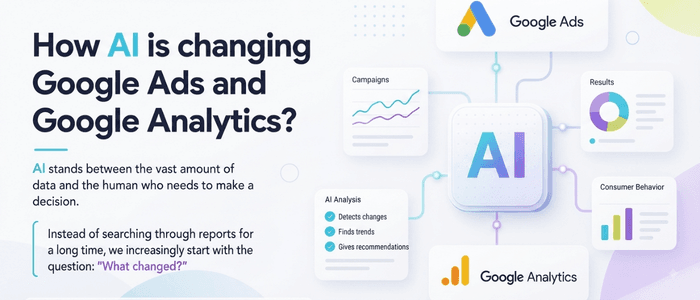
For years, the problem has rarely been a lack of data. More often, it has been the opposite - clicks, impressions, costs, conversions, revenue, audiences, devices, campaigns, and dozens of metrics that need to be connected into one meaningful picture.
The new direction is for AI to stand between this huge amount of information and the person who needs to make a decision. Instead of spending time searching through reports, marketers will increasingly be able to begin with a simple question such as: “What changed last week?” or “Why did conversions drop?”
Google Analytics Will Highlight Important Changes Faster
One of the most practical developments is the use of AI-generated summaries in Google Analytics. The idea is to highlight significant changes directly when users enter the platform - for example, a sudden increase in sales, a drop in traffic from a certain source, or an unusual change in customer behaviour.
This can save a great deal of time, but there is one important condition: the data itself must be accurate.
If conversions are tracked incorrectly, important actions on the website are missing, or traffic sources are not configured properly, AI cannot repair the foundation. It will simply analyze incomplete information faster.
That is why proper setup and tracking with Google Analytics becomes even more important. The more decisions are supported by automation, the more valuable accurate measurement becomes.
AI in Google Ads Will Help Identify Problems Faster
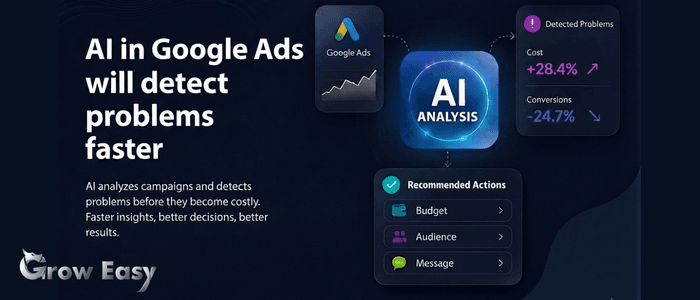
Google Ads is also moving toward a system where advertisers do more than simply look at tables and performance charts. AI can help identify unusual changes and direct attention toward areas that may require action.
Imagine that the cost of one campaign starts rising while conversions fall.
Traditionally, a specialist would need to notice the change, compare different periods, review several metrics, and gradually identify the most likely cause. AI can make part of this process significantly faster.
With AI, part of this process can be significantly accelerated, but faster signal detection is not a solution in itself - a specialist is needed to determine the true cause and take the appropriate action.
From Finding Data to Asking Better Questions
The traditional workflow often looked like this:
data → analysis → conclusion → action
Increasingly, it may look more like:
question → AI analysis → human judgment → action
The final step remains the most important one.
If AI identifies declining campaign efficiency, someone still has to decide what should change. Should the budget be adjusted? Is the advertising message weak? Is the audience wrong? Is the landing page failing to convert visitors? Or is the offer itself the real problem?
These are business decisions, not simply advertising metrics.
That is why professional Google Ads management will not become unnecessary because of AI. Instead, the focus will gradually shift from repetitive manual work toward interpretation, prioritization, and stronger strategic decisions.
Reports Will Become Easier to Create
Another important change is the move toward creating reports through simple text instructions.
Instead of manually selecting metrics, periods, dimensions, and visualizations, users will increasingly be able to describe what they want to understand.
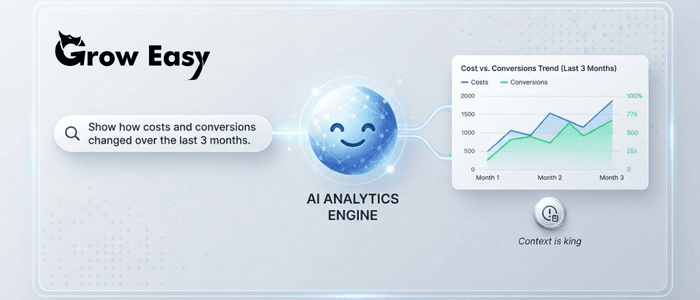
For example: “Show me how advertising spend and conversions changed over the last three months.”
The system can then create a relevant visualization and help explain what has happened.
This sounds convenient, and it is. But there is an important risk - a professional-looking report does not automatically mean that the conclusion behind it is correct.
Context Still Matters More Than the Chart
Data always needs context.
Comparing December with January may show a dramatic decline simply because of seasonality. A campaign with a higher cost per conversion may still attract customers with greater long-term value. A large number of enquiries may appear impressive, but they mean little if most of those leads never become paying customers.
AI can make information easier to access.
Strategy still has to give that information meaning.
Will AI Replace Google Ads Specialists?
Probably not. But it will change how they work.
Routine tasks are likely to take less time. Creating a standard report, spotting unusual performance changes, or reviewing a large dataset can become significantly faster.
But someone still needs to know what to look for.
Which customers are actually valuable to the business? How much can the company afford to pay to acquire them? Which service should receive more investment? Which conversion matters commercially? When is an algorithm optimizing a metric that looks impressive inside Google Ads but does not generate enough revenue?
These are the questions that turn advertising from a technical setup into a business strategy.
What Does This Mean for Your Business?
The easiest way to describe the change is simply: “Google is adding more AI.”
But the bigger shift is much more interesting.
Marketing platforms are gradually moving from places where we search for information to systems we can interact with and ask questions about that information.
This can make advertising analysis more accessible, but it also increases the importance of high-quality data. More powerful AI working with incorrect information does not automatically produce better decisions. It simply reaches conclusions faster on top of a weak foundation.
A similar transformation is already happening in online search. If this topic is relevant to your business, explore how AI website optimization for ChatGPT, Gemini and Google is changing the way companies need to think about their visibility beyond traditional search engines.
AI Will Analyze Faster, but Strategy Still Wins
The direction is clear - less time will be spent searching for the right report, while more attention will go toward deciding what should actually be done with the information.
AI summaries, automated analysis, and reports created through simple prompts can make Google Ads and Google Analytics significantly easier to work with. But there is still no button that can automatically turn a weak advertising strategy into a strong one.
The real advantage will belong to businesses that combine accurate data, proper measurement, a clear advertising strategy, human judgment, and the capabilities of AI.
If you are not sure whether your advertising and measurement setup reflects the real performance of your business, contact the Grow Easy team. We can look at what is working, where potential is being lost, and how your advertising and data can work better together!