See the most common mistakes and how to improve your results starting today.
Spending Budget on Google Ads but No Results? Here’s Where You’re Going Wrong
You launch Google Ads, invest budget, watch the clicks increase… but the customers are missing. The truth?
Google Ads in 2026 is an AI-driven system.
If you’re not feeding it the right signals, it will simply spend your budget on the easiest (but lowest-quality) clicks. Today, you don’t just “set up ads”—you train an algorithm.
And if you feed it the wrong data, weak messaging, or poor structure… the result is always the same: high traffic, low business impact.
In this GrowEasy article, we’ll break down where things usually go wrong—and how you can turn them around.
I’m Using Google Ads but It’s Not Working—Why?
Let’s start with something important—what is Google Ads?
If it’s not working for you, that doesn’t mean it doesn’t work at all.
Google doesn’t operate on a “plug and play” model. It’s a system that requires testing, analysis, and optimization.
Many businesses expect instant leads. But the reality is different—the first campaigns are often for testing.
Ask yourself this:
Do I actually know what I’m optimizing?
If the answer is “not really,” you’re in the right place.

The Most Common Google Ads Mistakes
Mistake #1: Wrong Keyword Strategy
Many businesses still believe they should only use long-tail keywords to get results. That used to be true.
But in 2026, Google Ads works differently.
Broad Match can be extremely effective… but only when used correctly.
The real mistake isn’t using broad keywords. The mistake is when:
- you don’t have enough conversion data
- you’re not using Smart Bidding strategies
- you haven’t set negative keywords
Ask yourself: Am I giving Google enough data to understand who my customer is?
Google no longer relies only on keywords—it uses AI to analyze behavior, intent, and signals.
But for this to work, it needs “fuel”—your data. If you don’t have conversion tracking or enough data, Broad Match can bring irrelevant traffic and make it seem like “it doesn’t work.”
On the other hand, when you combine:
- Broad Match
- Smart Bidding (e.g., Maximize Conversions)
- well-structured negative keywords
…you start seeing the real power of Google Ads.
Don’t be afraid of broad keywords. Be afraid of lacking strategy and data.
Mistake #2: Poor Targeting
Even with good keywords, if you target the wrong audience—you’ll still get poor results.
A common scenario: your ads show across the entire country, but you only serve one city.
Or you target everyone instead of users with specific intent.
Ask yourself:
Is my ad showing to the right people at the right time?
Mistake #3: Weak Ad Copy
Imagine seeing an ad that says:
“Quality services. Good prices. Contact us.”
Would you click? Probably not.
Google Ads is not just technical—it’s psychological.
If your message doesn’t grab attention or speak to the customer’s problem, it will be ignored.
People don’t search for products—they search for solutions.
AI Ad Formats (RSA and Ad Strength)
If you still think of ads as a single sentence—that’s a problem.
In 2026, Google Ads uses Responsive Search Ads (RSA).
That means you don’t write “one ad”—you give variations, and Google assembles the best combinations.
The big mistake?
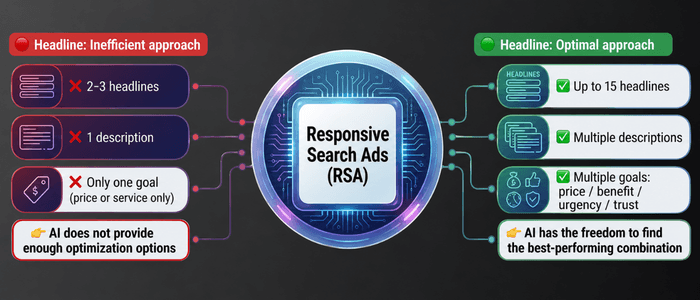
Many businesses add 2–3 headlines and 1 description… and expect results.
In reality, you should provide:
- up to 15 headlines
- multiple descriptions
- different angles (price, benefit, urgency, trust)
Why?
Because AI tests combinations and optimizes in real time.
What about Ad Strength?
Google gives your ad a rating. If it’s “Poor” or “Average,” it’s a clear signal you’re not providing enough variation or value.
And yes—it directly impacts performance.
Low Ad Strength means:
- fewer impressions
- higher cost per click
- lower efficiency
What Else Is Missing?
In 2026, text is not your only asset.
Google increasingly integrates:
- images
- videos
- asset groups (even in search campaigns)
If you’re not using these formats, you’re already behind.
You’re not writing ads—you’re building a “signal system” that AI uses to find the right customer.
Mistake #4: A Landing Page That Can’t Hold Attention (Especially on Mobile)
You can have a perfect Google ad…
But if your page is slow or confusing, you lose the customer before they even see your offer.
In 2026, this is even more critical.
Users don’t wait.
If your page doesn’t load almost instantly, they leave and choose a competitor.
Key Factor: Mobile Speed and LCP
Google measures this through Core Web Vitals.
The most important metric here is:
LCP (Largest Contentful Paint)—how fast the main content loads.
If it takes more than ~1.2–2 seconds on mobile… you’re already losing.
And not just users—you’re losing position in the ad auction.
What This Means in Practice
User clicks your ad → page starts loading → 1 second… 2 seconds…
They’ve already hit “back.”
Even your best headline doesn’t matter if no one sees it.
How to Fix It
Focus on:
- speed (especially mobile)
- clear focus (one goal = one action)
- strong first impression (above the fold)
In Google Ads, the winner isn’t the best ad—it’s the best post-click experience.
Mistake #5: No Tracking
This is critical.
If you don’t have conversion tracking set up, you’re basically “shooting in the dark.”
You don’t know what works, what doesn’t, or where your money goes.
Without data—there is no optimization.

Mistake #6: Bad Data (Garbage In, Garbage Out)
You can have perfect ads, strong keywords, and a solid budget—and still get no results.
Why?
Because Google doesn’t know who your customer is.
In 2026, advertising no longer relies on third-party cookies like before.
If you don’t provide quality data, Google has nothing to work with.
Ask yourself:
Am I giving the algorithm real signals about who buys from me?
If not, Google optimizes for people who click—but don’t convert.
This is the classic case of: Garbage In, Garbage Out.
What’s Usually Missing?
The biggest gap is lack of first-party data.
This includes:
- real customer lists
- emails and phone numbers (uploaded to Google Ads)
- CRM data
- Enhanced Conversions
Without these signals, Google cannot train its AI model.
What This Means in Practice
Imagine telling Google:
“Find me customers.”
But you don’t tell it who your customers are.
Result? The algorithm guesses—without direction.
That leads to wasted budget and low ROI.
How to Fix It
Start with Enhanced Conversions—this helps Google connect real users with conversions.
Then use Customer Match—upload real customer lists to give the algorithm a benchmark.
Most importantly—treat data as an asset, not a byproduct.

How to Improve Your Google Ads Results
The good news? All of this can be fixed.
Start with keywords—refine targeting, add negative keywords, eliminate irrelevant traffic.
Then review your ad copy. Don’t describe—persuade.
Clearly communicate your value and why someone should choose you.
Even small copy changes can lead to massive performance improvements.
Choose the right campaign type (Search vs. PMax vs. Demand Gen)—this is a strategic decision that defines your results. Define to which Google Ads types your ad goes to.
Then optimize your landing page—make it clear, fast, and focused on a single action.
And most importantly—set up proper tracking.
Everything else builds on that.

How Long Does It Take for Google Ads to Work?
This is one of the most common questions.
Google Ads can start delivering results relatively quickly—but optimal performance takes time.
The first 2–4 weeks are usually for data collection.
After that comes real optimization.
If you expect overnight results—you’ll be disappointed.
If you treat it as a process—you’ll win.
When Is It Time to Hire an Expert?
Sometimes, the best decision is not to do everything yourself.
If you’ve already spent budget without results…
If you don’t have time to analyze and optimize…
Or if you want faster growth…
Then working with a Google Ads marketing expert can save you time, money, and stress.
Your Google Ads Work—When You Manage Them Properly
To summarize:
The problem isn’t that Google Ads doesn’t work.
The problem is in the details—keywords, targeting, messaging, landing page, and data.
The good news?
Every one of these issues can be fixed—often faster than in any traditional marketing channel.
And that’s where the opportunity lies.
Because when you optimize correctly, results don’t just improve… they multiply.
The question is:
Will you keep wasting budget—or start investing it?
If you want clear answers and actionable steps, book a free Google Ads audit consultation with GrowEasy and put your campaigns in safe hands.
We can improve your existing campaigns, create new ones—or both.